
.
Author Archive
Nov
13
2009
India From An Enfield
.
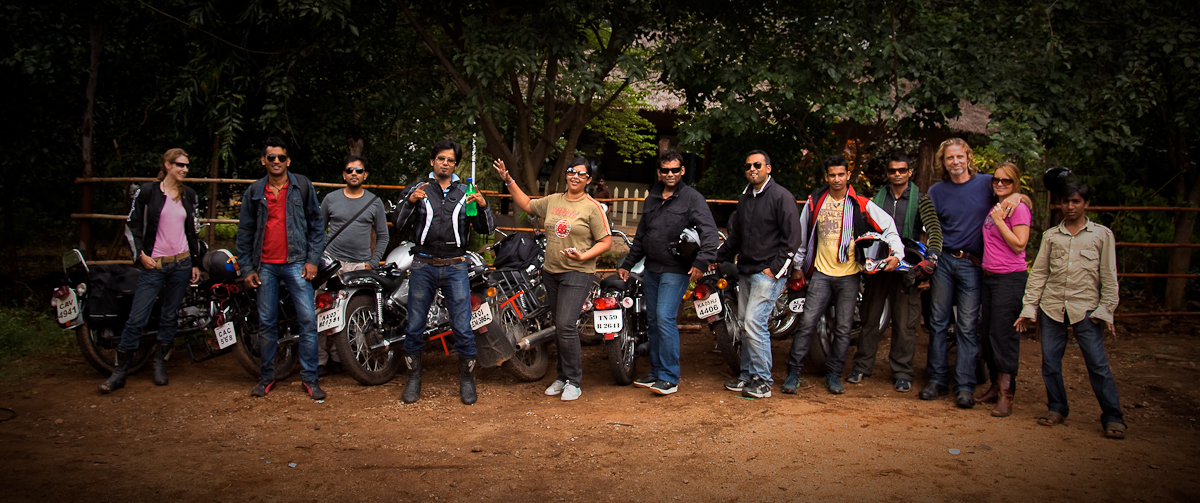
We are taking off for the weekend on a bike journey with our new pals Gautam and Venetia, and a surly group of Enfield riders from the notorious Road Veda MC. No cuts yet, but we are still prospects only ;)
Our destination is Galibore, a fishing village on the other side of the ghats. A bunch of Bullets, bitches riding pillion, a backup car, medical personnel and a mechanic; if you see us coming, you best get out the way.
Oh and once we get there, we will be rafting with crocodiles.
Oct
18
2009
It’s English… and it’s very, very broken.

.
After India gained Independence in 1947, a heated public debate ensued about how to tie the newborn nation together with an official language. Hindi was the proposed candidate, but it was controversial for a number of reasons. For instance, the lower castes were concerned that the caste-based prejudices built into the Hindi language would seal their class-fates forever. They felt that English was a more “democratic” language, which might level the social playing field some. However, having just expelled the British, the notion of adopting their language as India’s official tongue was anathema to many.
A compromise was required: India would postpone the decision for 15 years, after which time the whole kerfuffle might be forgotten. I know, it sounds brilliant on paper, but after 15 years, the controversy reignited, and an absolute decision was made: India would have (absolutely) two official languages: Hindi AND English.
India’s current state lines were drawn in 1956 based on major regional linguistic boundaries. There are now 28 states and 7 territories, so there is an equivalent number of major regional languages; and there are myriad other local tongues within each. To these hundreds of languages, the British had already added their own brand of military beaurocratic English. The resulting street-level linguistic fustercluck™ is a combination of innumerable mispronunciations of innumerable regional transliterations of imperial office-English from a bygone age.
What this means in practical terms is that people here speak a bit of Hindi, a bit of English, the language of their state, and likely a language from their “native place,” or birth village. Therefore, we depend upon English to do the heavy lifting, seeing as how our Hindi, Malayalam, Kannada, and so on, are not too good. The fundamental mistake we make, almost every day, is to assume that what we think of as English is the same as what others think of as English ;)
We have by now decided that communication is likely much easier in France, Germany, Spain, Japan, or anywhere where it is understood from the start that we speak a wholly different language. In India, we assume a common language and proceed to have an “English” conversation with a tailor, policeman, grocer, driver, for 5, 10, 15 minutes before it becomes clear that absolutely no communication is occurring. Multiply this by every phone call or casual transaction each day, and… woof.
Speaking English words is not the same as speaking English…
Oct
16
2009
Happy Diwali, Everyone !

.
We found this incredible poster, advertising exploding caps for toy guns, on an afternoon run across state lines to Tamil Nadu to buy loads of cheap, volatile fireworks for Diwali. We drove back into Karnataka with a trunkload of combustible cargo that would have made Hunter S. Thompson nervous.
The fireworks shops spring up at the border this time each year, packed tightly, several deep and out into the distance as far as the eye can see. It’s truly over the top. And the merchandise itself was well beyond the pitiful stuff we see in the States. These places are fully stocked with serious Roadrunner-vs. Coyote ACME firepower.
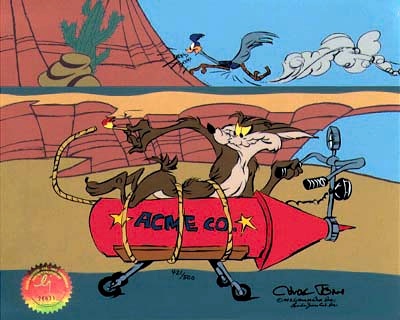
But firepower was not what held my attention: it was the packaging. Boxes with utterly random combinations of elements: princesses, swastikas, explosions, cartoon characters, movie stars, porn starlets, Hindu gods… Hopefully we can post some samples soon. And the promotional posters were fantastic; I asked the vendors if they could spare any, and they looked at me like I was insane to want such trash. This one has now been framed and is hanging on our wall :)
Oct
16
2009
Phil Speaks

.
I spoke at this event called Design Fridays last week. It’s a long-running, subscription-based, quarterly event produced by Ray+Keshavan, a premiere international branding firm here in Bangalore. The event consists of a presentation by someone noteworthy from a given creative field, followed by Q&A, followed by dinner, cocktails, and enlightened conversation. Attendees are a nice variety of people from many creative disciplines, lively and engaged. Pam and I had attended the previous one as guests, and had a really fantastic time.
My talk was called “Desire and Digital Design.” My intention was to examine the differences between design/designers in India and design/designers in the west, and to spend some time looking at the evolution of UI design as a distinct discipline over the last 15 odd years. The juxtaposition of India and the U.S., as seen through the lens of design, is actually a very interesting subject, one I grapple with and reformulate every single day here. My working theory at the moment entertains the notion that desire is a fundamental component of the act of design; and that desire itself has been systematically bred out of the culture here for thousands of years. That’s just the top level; there are many other forces in play: politics, education, history, geography, literacy, language, religion, and more. Each has a distinct role in suppressing desire, and in turn, design. There is reason for hope, there are green shoots – I closed the talk with an examination of one particularly inspiring story – but India’s cultural model is the stream against which aspiring designers here are all swimming.
I’m pretty sure I managed to offend some in the crowd, regardless of my academic intentions. I know because they told me so ! Engaging men and women, architects, photographers, journalists, typophiles… We had fantastic talks about what India truly is, how I may have misperceived, and when we might dine together properly and have a *real* conversation :)